丁未 · Fire Goat
2027, the year of the Goat
Chinese New Year falls on 6 February 2027. The solar year turns three days earlier, on 4 February at 09:46 Beijing time — and the two calendars disagree about which year you are in until they catch up.
- Year
- 丁未 Dīng Wèi — Fire Goat
- Begins
- 6 February 2027 (Chinese New Year)
- Solar year begins
- 4 February 2027, 09:46 Beijing time
- Annual star
- 九紫 Nine Purple in the centre
- Age
- 九運, the ninth age (2024–2043)
- Previous Fire Goat
- 1967
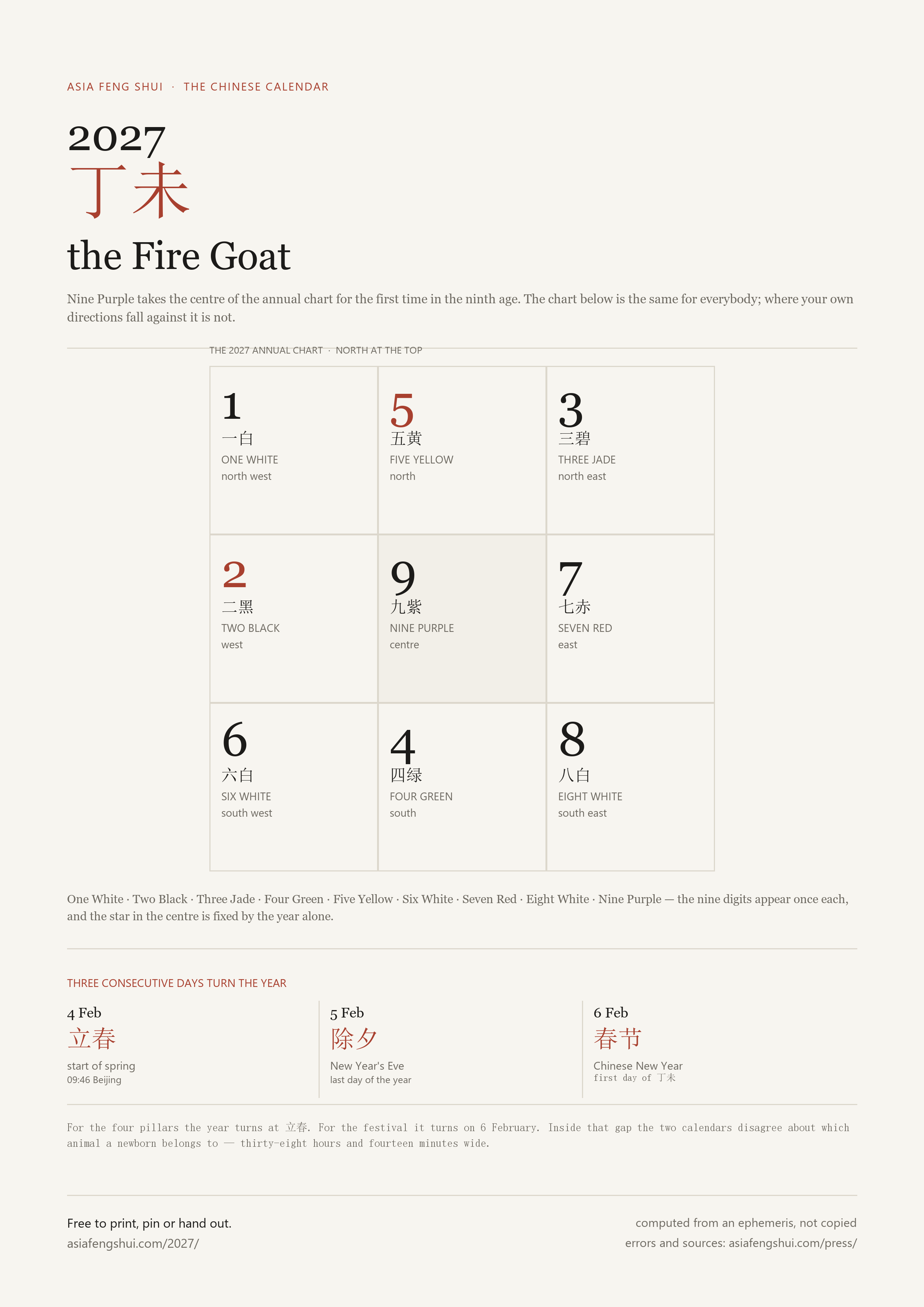
Take the chart off the screen. The 2027 annual chart, the three days of February and the star of each palace are set on one A4 page at 300 dpi, north at the top. It is free, and you do not have to ask.
Chart
The 2027 flying star chart
九紫 in the centre, 五黄 in the north, 八白 in the south-east. The full square, with what each palace does this year.
Open →Calculator
Your Kua number
The 2027 chart is the house. Your Kua number is you. You need both before either means anything.
Open →Calculator
Your four pillars
2027 is a Fire Goat year. What that does to you depends entirely on what your own chart is made of.
Open →Pairing
Goat compatibility
The Goat harmonises with the Horse, the Pig and the Rabbit and clashes with the Ox. Put two birth dates against all six relations.
Compare two dates →Free preview
2027, against your chart
The nine annual stars placed on the eight directions that belong to you — including the sectors where the two readings collide.
See your year →The year 2027 has a full name: 丁未, Ding Wei. One character comes from the ten Heavenly Stems, the other from the twelve Earthly Branches, and between them they fix the year's element, polarity, season and direction. English usually shortens the pair to the Year of the Goat, or the Year of the Fire Goat — or, keeping the polarity, the Yin Fire Goat. Accurate as far as it goes, and leaving out nearly everything that makes the year worth writing about.
What follows is a reference page. It sets out what the name means, why the first week of February behaves unusually, where the annual stars sit, which animals the Goat meets and how, and when the year actually ends. It is not a forecast and it does not pretend to be one.
What 2027 actually is
A year in the sexagenary cycle is named by pairing a stem with a branch. The stem carries polarity and element; the branch carries element, season, direction and an animal. Neither character is an adjective applied to the other. 丁未 is a single term, read as one word, the way a date is read as one day rather than as a month plus a number.
丁 is the fourth of the ten stems, and it is yin. Its element is Fire. 未 is the eighth branch, and it is also yin; its element is Earth, its season is late summer, its quadrant is the south-west, and it belongs to the territory of the 坤 Kun trigram. A branch is not only an animal. The Goat is the picture the tradition hangs on the branch so that the sequence can be remembered. The branch itself is a position — in the year, the month, the day, the hour, and on the compass.
Set the year beside its neighbours and the pairing becomes clearer.
| Year | Pair | Reading |
|---|---|---|
| 2026 | 丙午 | Yang Fire over the Horse |
| 2027 | 丁未 | Yin Fire over the Goat |
| 2028 | 戊申 | Yang Earth over the Monkey |
Fire appears at the stem in both 2026 and 2027, first as yang Fire and then as yin Fire. 2028 changes the element as well, to yang Earth. Yang and yin are labels of polarity, not grades; 丙 and 丁 are both Fire, distinguished by polarity rather than by rank. 2027 is a yin year set between two yang ones.
Put the two characters together and 2027 is Fire over Earth: a yin Fire stem sitting on a yin Earth branch. That much is arithmetic. What the combination means is where the schools divide, and this page keeps the division visible rather than resolving it. A reader meets confident summaries of the Fire Goat elsewhere. The name by itself supports none of them.
The branch's season needs a note, because it confuses readers every year. 未 is the late-summer branch, which sounds wrong for a year that begins in February. It is not wrong. The branch marks a position in the solar year, and the Goat month falls in July and August, not at the new year. The new year is a lunar event; the branch is a solar one. 2027 contains both, and they do not line up.
Nothing in the name sets the weather, the markets or the mood of a country. It fixes a position and a set of relations: which branch the year sits on, which animals meet it and how, which star visits which palace. Everything beyond the position is interpretation, and interpretation belongs to a school.
The three-day hinge: 立春, New Year's Eve, New Year's Day
In 2027 the first week of February does something worth pausing over.
| Date | Day | Event |
|---|---|---|
| 4 February 2027 | Thursday | 立春, 09:46:18 Beijing time (01:46:18 UTC) |
| 5 February 2027 | Friday | New Year's Eve |
| 6 February 2027 | Saturday | Chinese New Year |
Three consecutive days, three different new years. 立春 is the solar new year of the BaZi calendar. New Year's Eve is the last day of the lunar year. New Year's Day is the first day of the next one. The arrangement is uncommon but not unique; this page does not put a frequency on it, because a frequency would need a run of years it has not computed.
立春 is the term that begins the BaZi year. The year pillar does not change on 1 January, and it does not change on Chinese New Year; it changes at the instant of 立春. In 2027 that instant is 09:46:18 on Thursday 4 February, Beijing time — 01:46:18 the same morning in UTC. One event, two clocks.
The precision matters to a chart. A birth at 09:00 Beijing time on 4 February falls before the change and carries the 2026 year pillar, 丙午. A birth at 10:00 carries 丁未. Both birthdays are on the same date and would sit on the same line of a family record. In a BaZi chart they are in different years.
Then there is the popular new year. Chinese New Year's Day 2027 is Saturday 6 February, and New Year's Eve is Friday 5 February. The sequence runs: the chart's year changes on Thursday morning, the lunar year ends on Friday night, the lunar year begins on Saturday. Between the Thursday instant and Saturday, the zodiac year and the popular year disagree. A child born in that window carries the Goat year in a BaZi chart and is still in the Horse year by the calendar on the wall until New Year's Day.
What follows from the hinge is bookkeeping — which year pillar a chart uses, which month pillar, which page of an almanac a date belongs on. It is not an omen. Three days carrying three new years is a calendrical knot, and untying it is the whole of the exercise.
Nine Purple returns to the centre
Period 9, 九運, runs from 2024 to 2043. In 玄空飛星 a period is a long span with a star of its own, and the star of Period 9 is 9 Purple, associated with the 離 Li trigram: Fire, the south, visibility, screens, air, and the middle daughter. The period star occupies the centre of the period's own chart. The annual star moves through the palaces year by year, and the star that lands in the centre gives the year its number.
Here is the run around 2027.
| Year | Annual centre star |
|---|---|
| 2024 | 3 Jade |
| 2025 | 2 Black |
| 2026 | 1 White |
| 2027 | 9 Purple |
| 2028 | 8 White |
The count runs down by one a year and wraps: 3, 2, 1, then 9, 8. 2027 is not the beginning of Period 9; the period began in 2024. It is the first year inside the period in which the annual star and the period star are the same number. Both are 9, and both are Purple.
That agreement is the reason this page exists. In the school's own terms it is a fact of construction: the annual 9 has arrived in the palace where the period's 9 already sits. Whether the doubling is read as emphasis, repetition, opportunity or caution is not settled by the chart. Practitioners differ, and the difference is interpretation. The chart shows the overlap; it does not prescribe a response.
Period 9's associations are often quoted as if they were events. 離 is the trigram of Fire and of the south; its images include visibility, screens, air and the middle daughter. Those are attributes of the trigram, not period-specific forecasts; the period borrows them for its span. What a culture or an industry does with them is not contained in the trigram.
One further caution. The period star at the centre is one position on a nine-palace board. It does not cancel the other eight, and it does not make the year uniform for everyone living in it. The chart is a map of one layer, and the next section lays that map out.
The 2027 palace chart
The fixed square behind every annual chart is the 洛書, the Lo Shu: 4 9 2 / 3 5 7 / 8 1 6. Each number belongs to a palace — 1 north, 2 south-west, 3 east, 4 south-east, 5 centre, 6 north-west, 7 west, 8 north-east, 9 south. The 2027 annual stars are placed into that square, one to a palace. Drawn with south at the top, so that the palace order matches the 洛書, the chart reads:
- South-east 8 White · South 4 Green · South-west 6 White
- East 7 Red · Centre 9 Purple · West 2 Black
- North-east 3 Jade · North 5 Yellow · North-west 1 White
Read in compass order instead, the same chart is:
| Palace | Annual star | The school's conventional label |
|---|---|---|
| North | 5 Yellow | obstruction and delay; Earth |
| North-East | 3 Jade | speech and litigation; the quarrel star |
| East | 7 Red | eloquence and loss; the mouth star |
| South-East | 8 White | accumulation; the wealth star |
| South | 4 Green | romance and study |
| South-West | 6 White | authority and promotion |
| West | 2 Black | illness, stillness and rest |
| North-West | 1 White | career and communication; the travelling star |
| Centre | 9 Purple | celebration and recognition; the joy star |
Two placements attract most of the commentary.
The five yellow in the north
In 玄空飛星 the 5 Yellow is the star of obstruction and delay, and its visit to a palace is treated as a reason not to disturb that sector. The convention is concrete: no renovation, no drilling, no knocking through a wall in the north of a building during 2027, or at least none without a practitioner's advice. The avoidance is not a claim that the star is malicious; it is that the school classifies 5 as a star better left quiet. The convention is a convention. Nothing about it is measurable, and this page does not recommend an object for it.
The two black in the west
In the school's vocabulary the 2 Black is the illness star, associated with stillness and rest, and in 2027 its palace is the west. The conventional treatment is metal — a metal object, six coins, a brass bell — placed in the sector so that the star's Earth is drained by Metal. Again this is a convention of the school rather than a measured effect, and a reader who does not follow the school is not thereby at risk. The chart is a description inside a system.
Where the eight and the nine sit
The 8 White, which the school reads as the wealth star, is in the south-east this year. The 9 Purple, the star it reads as joy, is in the centre — the doubled position described above. The school's treatments cluster around these two palaces, which it treats as accumulation and celebration. The operative word is treats. A chart does not move money or arrange a wedding. It labels a sector.
The chart is one layer. A building has its own chart, computed from its facing and its construction date, and the annual stars visit that chart rather than replacing it. A person has a chart too. The 2027 palace chart on its own says where the year's stars sit, not what any particular house or person should do about them. That is the difference between a reference table and a reading.
The twelve animals in 2027
Popular writing reduces the year to one animal and then sorts the other eleven into lucky and unlucky. The scheme itself is more specific and less judgemental: each branch has a defined relationship to 未, and the relationships have names. Here is the whole set.
| Animal | Branch | Relations to 未 in 2027 |
|---|---|---|
| Rat | 子 | 害, harm |
| Ox | 丑 | 冲 clash and 刑 punishment |
| Tiger | 寅 | none of the five |
| Rabbit | 卯 | 三合, three-harmony |
| Dragon | 辰 | none of the five |
| Snake | 巳 | none of the five |
| Horse | 午 | 六合, six-harmony |
| Goat | 未 | 值太歲, the year's own sign |
| Monkey | 申 | none of the five |
| Rooster | 酉 | none of the five |
| Dog | 戌 | 破 break and 刑 punishment |
| Pig | 亥 | 三合, three-harmony |
The harmony relations
Two schemes carry the name harmony. The 三合, three-harmony, groups three branches a third of the circle apart. 亥卯未 — Pig, Rabbit, Goat — forms one such frame, and its element is Wood. In 2027 the Pig and the Rabbit are in the Goat's three-harmony set, and the Goat completes it. The 六合, six-harmony, is a pairing scheme, and the Goat's partner is 午, the Horse. A reader who has heard that the Horse and the Goat go together has heard the six-harmony rule. It is a rule of the system, not a description of two people.
The clash, the harm and the break
The 冲, clash, is the opposite branch: 丑, the Ox. The 害, harm, is 子, the Rat. The 破, break, is 戌, the Dog. Each name has its own place in the branch literature, and each is used as a label for a kind of friction rather than a verdict on anyone born under that animal. In 2027 the Ox carries two labels, clash and punishment; the Dog carries break and punishment.
The punishment set
The 三刑, three-punishment, set is 丑戌未 — Ox, Dog and Goat — so 未 joins 丑 and 戌 in a construction that binds three branches rather than two. In 2027 the Ox and the Dog each carry 刑, and the year's own branch is the third member of the set. The set has three members and no ranking among them. This page names the relation and does not extend it into a prediction.
The year's own sign
The Goat is 值太歲, the year's own sign — the branch that holds the year. Popular writing often turns it into a difficult year for Goats, and the turn is an interpretation rather than a reading of the relation. 值太歲 names a position: the branch that defines the year is the one the year is standing on. Whether that is a burden, an honour or neither is a question for a practitioner, and practitioners disagree.
The five with no relation
Tiger, Dragon, Snake, Monkey and Rooster carry none of the five relationships used here — no harmony frame, no harmony pair, no clash, no harm, no break. That is all it means. The absence of a named relation is neither good nor bad; it is the absence of a label in this particular scheme. A reader who has been told that a Monkey has nothing to worry about in 2027 has been told something the table does not say.
The animal is one character. A year pillar is two, and a chart is four pillars of two characters each; sorting a year by one animal is using the smallest part of the system and calling it the whole.
Month by month
The Chinese year is divided by solar terms rather than by lunar months. Twelve terms begin a BaZi month; these are the 節. The twelve for 2027 are below, in Beijing time, with the month branch each one opens and the year pillar in force during that month.
| Term | Date in 2027 | Beijing time | Opens month branch | Year pillar in force |
|---|---|---|---|---|
| 小寒 | 5 January | 22:10 | 丑 | 丙午 |
| 立春 | 4 February | 09:46 | 寅 | 丁未 |
| 驚蟄 | 6 March | 03:40 | 卯 | 丁未 |
| 清明 | 5 April | 08:18 | 辰 | 丁未 |
| 立夏 | 6 May | 01:25 | 巳 | 丁未 |
| 芒種 | 6 June | 05:26 | 午 | 丁未 |
| 小暑 | 7 July | 15:37 | 未 | 丁未 |
| 立秋 | 8 August | 01:27 | 申 | 丁未 |
| 白露 | 8 September | 04:28 | 酉 | 丁未 |
| 寒露 | 8 October | 20:17 | 戌 | 丁未 |
| 立冬 | 7 November | 23:38 | 亥 | 丁未 |
| 大雪 | 7 December | 16:38 | 子 | 丁未 |
Three things follow from the table.
The first is the January anomaly. The first 節 of the civil year, 小寒, opens the 丑 month on 5 January at 22:10, but the year pillar is still 丙午. The yang Fire Horse of 2026 governs January 2027. The year changes on 4 February at 09:46, not on 1 January and not on Chinese New Year.
The second is the Goat month. 小暑 on 7 July at 15:37 opens the 未 month, which runs to 立秋 on 8 August at 01:27. In 2027 the month branch repeats the year branch: the Goat is on the year and on the month at once. Practitioners note the repetition, and what they make of it differs. For the calendar it is simply a consequence of the year being 未 and the month arriving in its usual place.
The third is the close. The last 節 of 2027 is 大雪, on 7 December at 16:38, which opens the 子 month. The BaZi year continues past it. 大雪 begins a month; it does not end a year. 丁未 remains in force until the next 立春, in February 2028, and a page that ends its 2027 table on 31 December is using the civil year while a chart is using the solar one.
All times are Beijing time, eight hours ahead of UTC. The terms are astronomical instants; only the clock reading changes with the time zone. A reader in Europe or the Americas finds the same terms at different local times, occasionally on a different date. Where a term falls close to midnight — 立冬 at 23:38 in 2027 is the closest of the twelve — a date-only almanac may place it on either side of the day, and two publications can disagree without either being careless.
How to use this page
This page holds five things, and they answer different questions.
- The name 丁未 answers what kind of year the cycle has produced: a yin Fire stem on a yin Earth branch.
- The three-day hinge answers which year a date belongs to, and why 4 February 2027 has two possible answers.
- The palace chart answers where the annual stars sit, one to a palace.
- The animal table answers which branches meet 未, and under which names.
- The month table answers when each BaZi month begins, and which year pillar is in force.
The page does not answer what will happen. That question lies outside the material, and it is the question most annual pages are written to answer, which is why they tend to sound alike.
Two habits make the page more useful. The first is to carry the time zone with the date. The 立春 instant is 09:46:18 Beijing time; a chart calculated elsewhere needs the instant converted, not just the date. The second is to check which convention a calculator uses. A tool that assigns a 4 February 2027 birth to the Goat year without asking for a time is using the popular new year; a tool that asks for a time is probably using 立春.
None of this requires belief. The arithmetic is checkable: the pairs are fixed, the times are instants, the chart is a placement. Interpretation is where judgement enters, and the page has tried to mark that line rather than blur it. A reader who takes only the tables has taken the part that can be checked; a reader who takes the readings is taking a school's account of them.
This site sells objects, not outcomes, and the same rule governs pages. This one describes a system of classification and promises nothing. It does not offer a better year, and it has no object to sell that would produce one. A sentence that reads as a promise has been written badly.
Notes on method
The calendar material is arithmetic. The 2027 pair, the 立春 instant, the dates of Chinese New Year and New Year's Eve, the twelve 節 times and the palace placements are computed or fixed values, given to the minute where a time is involved. The palace chart is reproduced from the annual star placement for 2027 rather than derived by the reader, and the 洛書 square is fixed. The almanac side of the material has its own reference literature, 《協紀辨方書》 among it.
The interpretive material is one school's reading. The annual stars and their conventional labels belong to 玄空飛星, whose principal modern text is 沈竹礽's 《沈氏玄空學》; the palace grid is the 洛書 square. The animal relations come from the branch literature and its standard sets — 三合, 六合, 冲, 害, 破 and the 三刑. Other schools frame the year differently, and within 玄空飛星 practitioners disagree about emphasis, treatment and what a placement is for. None of that disagreement is resolved here.
Nothing on this page is a prediction. The 5 Yellow convention, the 2 Black treatment and the readings of the 8 and the 9 are conventions of a school rather than measured effects. The page also declines to give a frequency for the three-day cluster of 4–6 February, because a frequency would need a run of years it has not computed. What the facts support is the phrase used above: uncommon, not unique.
The calendar arithmetic is computed, and the interpretation is one school's reading of a tradition. A reading is not a prediction. The line between the two is the most useful thing on the page.